
Welcome to Cosmocity Dental Practice – Where Smiles Shine Bright!

Routine check-ups and cleanings: Regular visits to monitor oral health and remove plaque and tartar buildup.
Fillings and restorations: Treatment for cavities and damage to teeth using materials like composite resin, amalgam, or crowns.
Preventive care: Advice and treatments to prevent dental problems, such as fluoride treatments, dental sealants, and oral hygiene education.
Extractions: Removal of damaged or decayed teeth when necessary.
Root canals: Treatment for infections in the tooth pulp to save a tooth.
X-rays: Diagnostic imaging to detect underlying issues not visible to the naked eye.
Periodontal care: Treatment for gum disease, including deep cleaning and advice on gum health.
General Dentistry:
Teeth Whitening: This involves removing stains to make teeth brighter and whiter.
Veneers: Thin shells of porcelain or composite resin that cover the front surface of teeth to improve their shape, size, or color.
Bonding: A tooth-colored resin applied to teeth to correct imperfections like chips, cracks, or gaps.
Crowns: A cap placed over a damaged tooth to restore its shape, size, and strength, improving both function and appearance.
Braces and Invisalign: Orthodontic treatments designed to straighten teeth and correct bite issues.
Dental Implants: A solution for replacing missing teeth by inserting a metal post into the jawbone, onto which a crown is placed.
Gum Contouring: Reshaping the gums to create a more even gum line.
Cosmetic Dentistry:
Pediatric dentistry focuses on the oral health care of children, from infancy through adolescence. Pediatric dentists are specially trained to manage the unique dental needs of young patients, including preventative care, diagnosis, treatment, and guidance for growth and development of teeth and gums.
This field addresses issues such as:
Teething and early childhood oral health care.
Preventative treatments like fluoride treatments, dental sealants, and education about proper brushing techniques.
Behavior management to ensure children are comfortable during dental visits.
Treatment for dental diseases and conditions like cavities, gum disease, and developmental issues.
Orthodontics (like braces or other treatments) for developing jaws and teeth
Pediatric Dentistry:

Emergency Dentistry
We offer emergency dentistry to address urgent and unexpected oral health problems that require immediate attention. These issues can arise from trauma, infection, or severe pain and often need prompt treatment to prevent further damage, alleviate discomfort, or avoid complications.
Common examples of emergency dental situations include:
Severe Tooth Pain: Often caused by infection, decay, or an abscess. Knocked-out Tooth: A tooth that has been dislodged due to an accident or injury. Chipped or Cracked Teeth: Breaks in the tooth due to trauma. Lost Fillings or Crowns: Leaving the tooth vulnerable to further damage or infection. Swelling or Abscesses: Infections that may cause swelling, fever, or pain in the mouth or jaw. Bleeding Gums or Mouth Injuries: When there’s significant bleeding that doesn’t stop.
frequently asked dental questions
It’s generally recommended to visit the dentist every six months for a routine check-up and cleaning. However, the frequency can vary based on individual needs, such as oral health conditions or risk factors like gum disease or cavities.
During a routine check-up, your dentist will examine your teeth, gums, and mouth for any signs of disease or other issues. X-rays may be taken to check for problems that aren’t visible to the naked eye. A professional cleaning will be done to remove plaque and tartar buildup.
Routine dental cleaning is generally not painful, but it may cause some discomfort, especially if you have sensitive gums or a lot of plaque buildup. My team and I may use a scaler to remove plaque and tartar, which can sometimes feel like pressure or vibrations.
X-rays help your dentist see areas between your teeth and under the gumline that are not visible during a regular exam. They can detect cavities, infections, bone loss, and other hidden issues.
If you have a toothache, it’s important to schedule a dental appointment as soon as possible. In the meantime, you can use over-the-counter pain relievers, rinse with warm salt water, and avoid very hot or cold foods until your visit.
A cavity is a small hole in a tooth caused by tooth decay. It can be treated by removing the decayed part of the tooth and filling it with a dental filling material like composite resin, amalgam, or ceramic.
Early signs of gum disease include red, swollen, or bleeding gums, especially when brushing or flossing. Bad breath and receding gums can also be indicators. If left untreated, gum disease can lead to tooth loss.
If you have a dental emergency, such as a knocked-out tooth, severe toothache, or broken tooth, contact your dentist immediately. In the meantime, you can apply a cold compress to reduce swelling and avoid eating or touching the affected area.
What can I expect after a dental procedure?
After a dental procedure, your dentist will give you instructions on post-care. You may experience some discomfort, swelling, or sensitivity, but these symptoms usually subside in a few days. Your dentist may recommend specific pain management strategies.
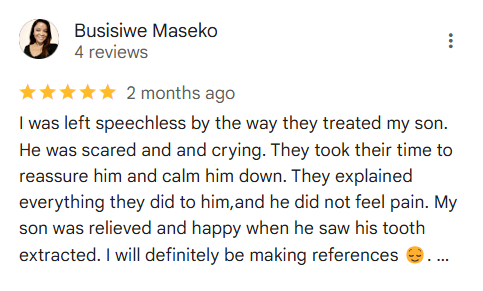
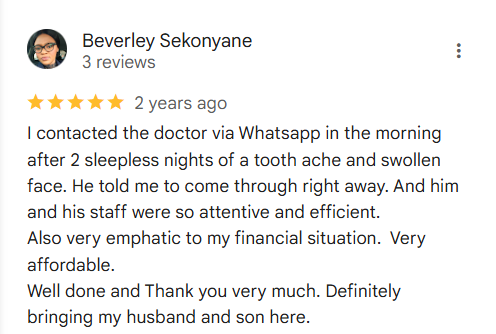
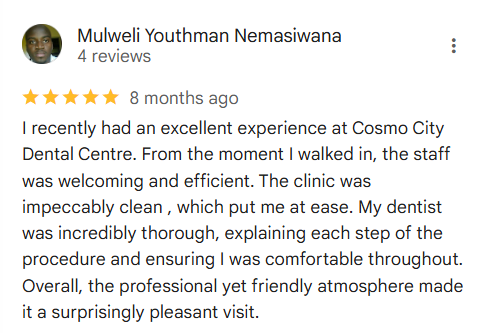
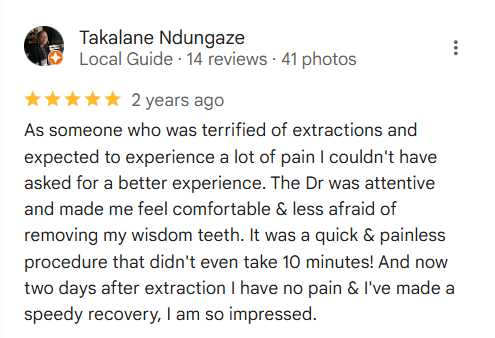
our Google reviews
Contact Us
82 Cnr Tennessee Avenue & S Africa Drive, Cosmo City, 2188, Roodepoort, City of Johannesburg Metropolitan Municipality, Gauteng, South Africa
Cell: +27 61 524 2458